Books

In January, one of the members of my four-woman book club  wanted to read something about Haiti since we all had to embarrassingly admit ignorance about this earthquake-ravaged country.  She suggested “Mountains Beyond Mountains,” by Pulitzer Prize-winner Tracy Kidder and now I’m suggesting it to y’all. Read this book and you’ll be like us: Beginning to understand the Haiti story that’s behind the headlines. “Mountains” is a non-fiction look at Paul Farmer, a brilliant, charmistic and compassionate Harvard-trained doctor and anthropologist who’s moved by the plight of Haiti’s poor. Farmer helped establish a community-based health project in 1983 in Cange, in Haiti’s Central Plateau near Port-au-Prince where an internationally financed dam had obliterated the peasants’ land and way-of-life — reducing them to less-than-subsistence. Farmer’s initiative, Partners in Health, has grown into a world-wide non-profit organization and Farmer is a recognized global authority on poverty-related health issues. Kidder’s book traces the development of PIH but focuses on Haiti. You’ll learn about the daily lives of its peasants and the almost unbelievable obstacles they face just to provide human basics for themselves. You’ll find out about Haiti’s history and culture and way of life — and you’ll come to respect and appreciate and be amazed at how the Haiti people survive. Learn more about PIH and its work in Haiti at http://www.pih.org and author Tracy Kidder at http://www.tracykidder.com/. Farmer’s Wikipedia entry has lots of good information, too, at http://en.wikipedia.org/wiki/Paul_Farmer.

Shopping

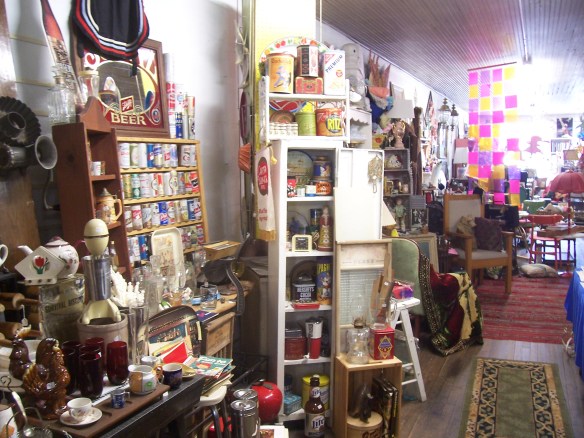
If a store can have a personality, then What’s on Second? in downtown Birmingham, Alabama, is geeky with a strong dash of uber-cool chic. It’s an antiques shop and a vintage boutique and a collectors’ paradise all in one … and the place where you’re going to come face to face with your childhood. After “Oh, wow, look at this!” the most commonly heard phrase among browsers  is “Oh, wow, I remember having one of those!” What’s on Second? is at 2306 Second Avenue North just a couple doors down from the Urban Standard coffee shop — the two must-go destinations are part of a downtown growth in art, music, food and style. The wooden floors and tin ceilings of the store’s two floors are as much a part of What’s On Second? as the somehow carefully arranged piles and stacks of … well, anything you can think of. There are postcards, books, posters, china, toys, clothes, lamps, household goods, tools, furniture, art work, jewelry, glassware, local history items — and that’s just your first few steps inside the front door. I asked the person behind the cash register once where all this came from — did the owners go to auctions and estate sales all the time? Turns out that most of the inventory comes from people bringing treasures in to sell. Prices seemed a bit high to me, but then I still can’t get used to spending $3.95 for a non-fat dry cappuccino so what do I know? At least it’s free — and fun — to browse and explore and maybe stumble across your own treasure. There’s no Web site, but you can call What’s On Second? at (205) 322-2688 for details.

Marriage — and Tweeting

It’s hard to believe how much technology has changed our everyday lives. When I was growing up in the 1960s, my family had one TV and one telephone — you needed parental permission to turn on the TV and you had to stay in one place to talk on the phone. How rich we felt as we graduated to more TVs — I had one of my own! In my room!!! — and more phones. I remember a Christmas when my brother and I were thrilled with our granddad’s gift to us: A reel-to-reel tape recorder. Talk about state-of-the art! Then, in the 1980s, it got harder to keep up with each newest thing — as soon as we got it, whatever “it” was, Version 2.1 came out. Changes kept coming, rapid-fire fast. It took me forever to remember to walk around and talk on cordless phones without being tethered to one spot — how amazing was it that you could take the phone into another room while you were talking? I used my paycheck from working at our church’s Mother’s Day Out program to buy one of those newfangled VCR things, and the delight my daughters found in watching Disney’s “Cinderella” over and over never diminished. Around that time, my then-husband laughingly dismissed a friend’s question wondering if we’d ever be able to play CDs in our cars, but of course, he’s also the one who shook his head in the mid 1990s at the preposterous idea of buying things over the Internet when I excitedly told him I could access the Simplicity sewing company and check out their patterns online — “That’s crazy. It’ll never work. Who’d want to do that?” he said. But, to be fair, he wasn’t the only skeptic. Weren’t we all, really? I mean, who would have thought years ago we’d have phones with us at all times and that we could watch movies and TV and listen to music anywhere we wanted? And who could have predicted I’d start every morning accepting virtual agricultural gifts and sharing my meandering thoughts with thousands of people I’ve never met? I love technology! And I love my now-husband, too — our relationship has spanned the range of communication from good ol’-fashioned e-mail to texting and tweeting. After, where would marriage be if we couldn’t keep up with our spouses 24/7? Read more at my weekly newspaper column at http://www.timesdaily.com/article/20091204/ARTICLES/912045004.

Farming

I don’t know what time it is in your part of the world, but here in northwest Alabama/northeast Mississippi/southern middle Tennessee, it’s cotton-picking time. Cotton is a top crop in Alabama, and the counties in my corner of the state are among the top producers state-wide.  (I looked that up at www.alfafarmers.org just to impress you all with my knowledge.) Cotton’s history in the South is a long and at times not an honorable one, but people all over — white, black, rich, poor — still have memories of back-breaking work in late-fall heat. I remember my maternal grandfather reluctantly sharing his less-than-happy cotton-picking experiences as a boy growing up near Jackson, Mississippi. Today, it’s pretty much huge machines that do the work, from what I can tell. And while it’s true that I know next to nothing about the cotton industry, I do think it’s encouraging that in our wireless nano-techno get-it-done yesterday world, sometime’s it still as simple as putting seeds in the ground … and hoping for the best.

Journalism — and Jewelry

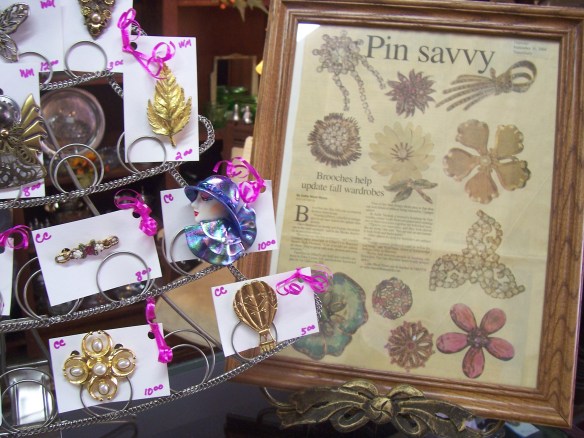
Antique mallsYounger Daughter and I recently were browsing through an antiques mall in Florence, Alabama, when she called me over to where she was standing. “Isn’t this your story?” she asked, pointing to a framed story from the local newspaper — the TimesDaily — about pins that was next to a display of wonderful vintage pins. And YD was right — there was my byline from my former days as a staff writer for the TimesDaily life section, before I retired almost two years ago to become a financially challenged but incredibly happy columnist and freelance writer. I have to say that it was sort of a strange feeling to see such care taken with a story I didn’t even remember doing — one of several hundred, probably, I don’t remember doing throughout the 10 years I worked in the TimesDaily newsroom. Yet there was my story, years later still stuck in black and white (well, sort of faded beige) and still influencing folks to think about buying a vintage pin because “brooches update fall wardrobes.” I have to admit it was a strange sensation to see this — a kind of out-of-body, did-I-really-write-that experience. Sort of makes you think. Sort of makes you hope you did a good job. Sort of makes you wonder how many other things you wrote are floating around influencing people to do things. Sort of makes you promise yourself to Write Only Good Things From Now On … beginning, maybe … tomorrow.

Family

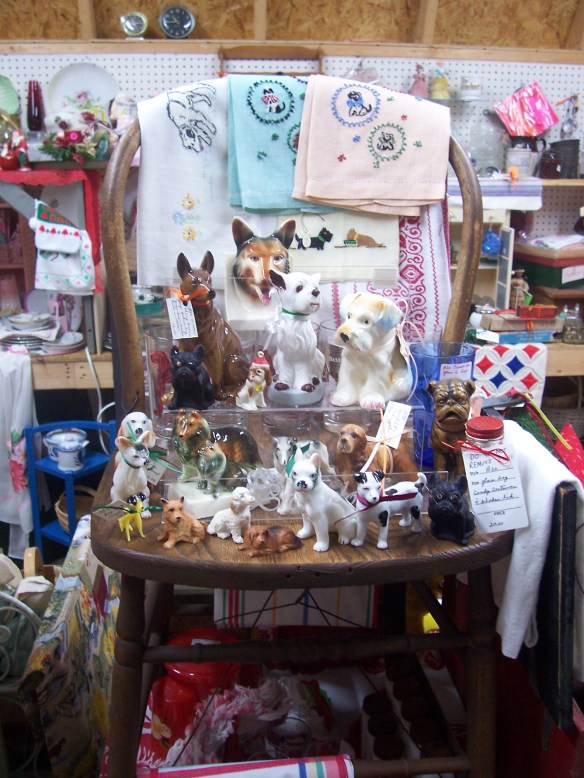
Ponderosa Tree Farm AntiquesHappy 75th birthday to my mom, Susan Wood, of Antiques Manchester, Tennessee, today! She is practically the most awesome person I know, and my goal is to grow up to be just like her. And since she hates having her picture taken, I’ve done the next best thing and put pictures here of just one of her claims to fame: her antique shop, Ponderosa Tree Farm Antiques. She is known far and wide as an antiques and auction expert and she’s gathered some of the results Tennessee antiquesof her sharp eyes and buying skills here in her antiques shop. She also has three booths at an antiques mall, but my favorite is her shop. I love wandering through and discovering new finds she’s rescued from folks Manchester, Tennesseewho don’t appreciate the value of a vintage flour-sack apron or a chunky retro beaded bracelet. She’s got dishes, books, kitchen ware, dolls, toys, clothes, linens and almost any other thing you might want to collect. And, listen, she does all this herself — and with help from my dad. She loads and totes and prices and organizes and cleans and presses — it’s exhausting just to think about, but she loves it. I cannot keep up with her. In fact, I can’t keep up with either of my parents — they pretty much put me to shame. Read more in my weekly newspaper column, http://www.timesdaily.com/article/20091030/ARTICLES/910305000, and have a happy birthday, Mom! Love you!!!

Books

The HelpYou have got to put The Help, a debut novel by Kathryn Stockett, on your must-read list. Set in Jackson, Mississippi, in 1962, this book is about the black women who work as maids, housekeepers and nannies for the town’s well-off white families. It’s narrated by two of those women, Aibileen and Minny, as well as a Skeeter, an Ole Miss graduate who comes home to her family’s cotton farm and begins to see the injustices in the white-woman-boss and black-woman-employee system she’d previously accepted unquestioningly. As the book unfolds and we learn more about how the white female bosses treated their black employees, you’ll be surprised, shocked and stunned — and never look at a Junior-League bake sale the same way again. But this isn’t a grim or humorless book. Stockett respects her characters and allows them to gently tell their stories in their own voices as we discover and examine along with (most of) them our own feelings about race and skin color. In fact, this book led to one of the most spirited discussions my four-woman book club has ever had as we each talked about our experiences growing up Southern during the Civil Rights ’60s and how those experiences affect our relationships with those who look different from ourselves. We talked about what exactly it means to be “racist” and were so grateful we’d read a book that made us examine prejudices we maybe didn’t even realize we had. But The Help is more than a chronicle of the burgeoning Civil Rights movement. It’s a delightful and uplifting story of the power of friendship, the strength of maternal love and the power of women’s determination to make a difference. Go to a bookstore, buy this book and then pass it on. You cannot miss out on one of the best books I’ve read this year.

Haunted Houses — and History

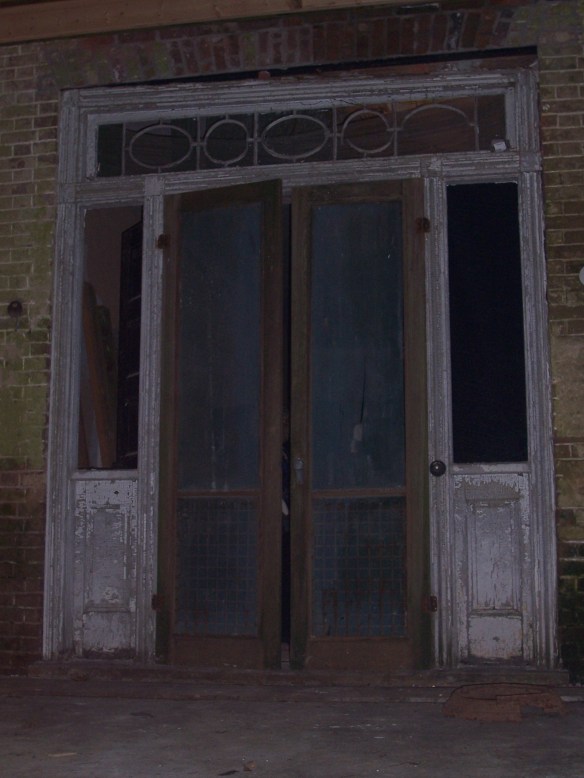
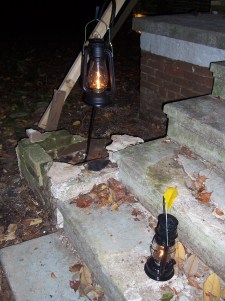
Florence, AlabamaSweetwater Mansion in Florence, AlabamaI do not like scary, bloody or gory stuff. I can barely sit through a CSI or Shark Week episode. Okay, that’s a lie — I cannot sit through a CSI or Shark Week episode. This is why I stay away from the “haunted houses” that open up during October around here. Other folks love to pay good money to scream and run away from axe-wielding zombies and come-to-life mummies, but not me, thank you very much. So when a haunted house opened up in Florence, Alabama, with the promise of only slightly spooky stories and a tramp around the grounds of a historic mansion, I was in. This is the HistorySweetwater Mansion, home to Robert M. Patton, who completed the home in 1835 (his father-in-law had started it a few years earlier). Patton was Alabama’s governor from 1865 to 1868. Sweetwater was a showplace that once included 3,800 acres of land and played host to many Civil War politicians and officers. Today, it’s neglected and deteriorating and surrounded by traffic and development — there’s a convenience store practically in the front yard. Owned by Susan Smithson, a former Shoals resident now living in Atlanta, Sweetwater and its remaining 22 acres are for sale, priced at several million dollars. Volunteers have banded together  to raise money for historic repairs and renovation and are sponsoring a haunted house this month. Some friends and I bundled up, fortified ourselves with a thermos of hot coffee and paid our $20 each. Our tour guide took us to five storytelling stations around the house and grounds (including the family graveyard), where we heard creepy ghost stories that scared us just enough and got close-up views of the house, the kitchen and the repair work that was underway. One of my friends took photos that showed spooky sort of orbs floating around. I didn’t get any of those on my photos — but losing this historic gem is scary enough. Learn more about the Sweetwater mansion at http://sweetwatermansion.com/

Renaissance Faire

Alabama Renaissance FaireThere is only one spot this weekend where you can converse with a Renaissance Fairetroll, dine on a roasted turkey leg and be presented to royalty: The Alabama Renaissance Faire in downtown Florence. And, why, you may ask, does Florence host the official Alabama Renaissance Faire? Well, for one thing, Ferdinand Sannoner, an Italian who helped surveyed the town in 1818, named it after Firenze, the beautiful Italian Renaissance city built around the River Arno just as the present-day Florence is situated on the Tennessee River. And for another, this is Ren Faire Alabama-family-style. There’s no drinking and no R-rated entertainment. You can bring both your grandmother and your grandchildren here without fear of embarrassment. In fact, education is a major part of the faire. Throughout October (and really all year long), Ren Faire volunteers visit local schools and give programs on life in Renaissance times. There are art, sonnet and chess contests for students, and high-schoolers get to help out at the faire for extra credit. Plus, the Faire is free, it’s in a small confined space — downtown’s Wilson Park, turned into the Fountain-on-the-Green for the duration — and it’s full of child-friendly crafts, food and fun. If you’ve ever shied away from a Ren Faire because you envisioned drunken pirates and way-too-buxom maidens running around, then this is the place you need to be — 10 a.m. to 6 p.m., Saturday, Oct. 24 and noon to 6 p.m., Sunday, Oct. 25. Go to http://www.alarenfaire.org/ for more info on the Alabama Renaissance Faire.

Food

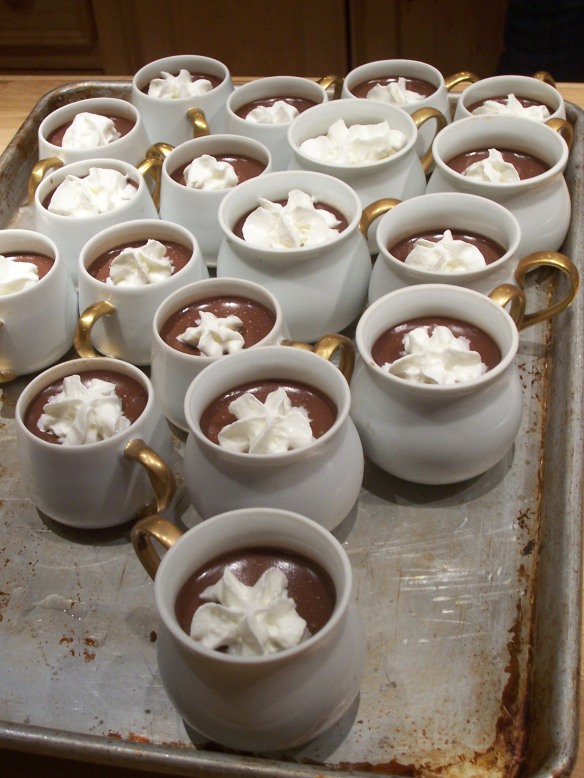
Chocolate Pots de CremeI don’t know which I liked better — this gorgeously rich and smooth chocolate pots de creme or the adorable little china “pots” it came in. This was dessert at a recent cooking class I took in Decatur, Alabama. Cookbook author and former restaurant owner Betty Sims teaches classes in her home each fall. This year she led off with “Celebrating Julia,” a menu based on Julia Child recipes. Betty has stayed at Cooking With Friends in France, http://www.cookingwithfriends.com/, a culinary program in Child’s former Provence chateau, and she has some great stories and photos. And great recipes, like this one for Chocolate Pots de Creme.

Chocolate Pots de Creme

Preheat oven to 325 degrees. Warm 2 cups heavy cream, two cups half-and-half and 4 ounces bittersweet or semi-sweet chocolate chips in a 2-quart Pyrex cup in microwave for 2 minutes on high. Whisk and microwave 2 minutes more until steam rises and chocolate is melted.

Whisk 6 egg yolks, 2 eggs, 1/2 cup unsweetened cocoa powder and pinch of salt together in a bowl. Add warm chocolate mixture in a slow stream, whisking constantly. Stir in 2 teaspoons vanilla extract and strain into a measuring cup with a pouring spout (to get rid of  lumps). Spoon off any foam. Divide mixture among six 3-ounce pot de creme molds or oven-safe ramekins. Cover each mold tightly with a lid or foil (although Betty didn’t do this and said it wasn’t necessary). Arrange molds in a baking dish, being careful not to let molds touch each or sides of dish (again, Betty didn’t do this and said it wasn’t necessary). Transfer dish to oven and add hot water to reach about halfway up outsides of molds.

Bake 35 minutes, then check for doneness. Custard should be just set but still quiver like gelatin. If necessary, bake another 3-5 minutes. When custards are set, remove from water bath and cool for 30 minutes at room temperature. Chill until completely cold, preferably overnight. Garnish with whipped cream.